My Discussions with David About Psychology
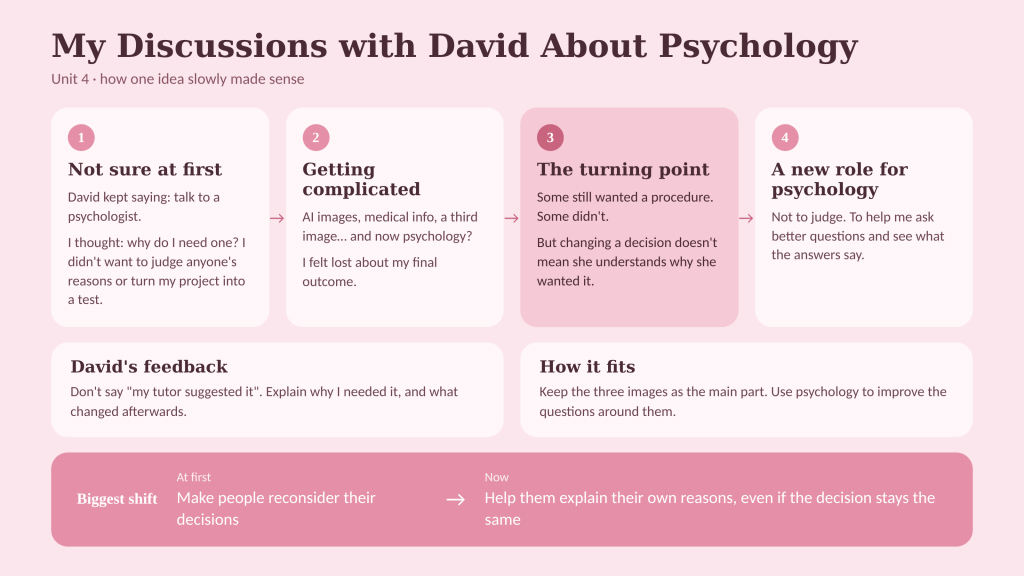
During Unit 4, David suggested several times that I should speak to a psychologist about my project.
At first, I wasn’t really sure about this idea.
My project was mainly about using AI images and questions to help women think about why they wanted to change their appearance. I wanted to keep it simple. Participants could look at their original photos, compare them with their ideal AI images, and then talk about how they felt.
But David thought psychology was an important part of my research. He wanted me to understand more about why people want to change their appearance and how I could tell whether they were actually reflecting on their decisions.
I understood what he was saying, but I was still a bit confused.
I kept thinking, why do I need a psychologist for this? Am I supposed to analyse my participants’ mental health? Or am I supposed to create some kind of psychological test?
That wasn’t what I wanted to do.
I didn’t want my project to become something where I judged people’s reasons for having aesthetic procedures. I also didn’t want to tell participants that wanting to change their appearance because of social media or other people’s comments was wrong.
I felt that everyone should be able to make their own choices.
I just wanted to give them a chance to think about those choices before making a decision.
Another thing I was worried about was that my project was becoming more and more complicated.
I had already started working with AI images, and later I wanted to bring in medical information and a third image. If I added psychology as another big part of the project, I wasn’t sure what my final outcome was supposed to look like anymore.
Was I still making a three-image intervention? Or was I now supposed to create a whole system?
I remember spending quite a lot of time thinking about this.
Around 22 October, I started writing down some questions that I wanted to ask David.
I wanted to know what I should actually talk about with a psychologist, how much psychology I needed in my project, and whether it would change the direction of my work.
I also started preparing questions for the psychologist, but I wasn’t happy with some of them.
A lot of the questions were about things like beauty standards, social media and appearance anxiety.
They were related to my topic, but I kept feeling that they weren’t really helping me improve my intervention.
I didn’t want to speak to a psychologist just so I could say that I had spoken to one.
I wanted to understand what I could actually learn from that conversation.
Things started to make more sense after I looked at the results of my intervention with medical information.
Some participants still wanted aesthetic procedures, some wanted to learn more, and others decided they didn’t want to consider a procedure for now.
At first, I thought this was a good result because people were starting to reconsider their choices.
But then I started asking myself something.
If someone decides not to have surgery because she’s scared of the risks, does that mean she understands why she wanted surgery in the first place?
Maybe not.
And if someone still wants surgery after knowing about the risks, does that mean she hasn’t reflected?
Not necessarily.
This was when I started to understand what David had been trying to get me to think about.
I had been paying too much attention to whether participants changed their decisions.
But my research question wasn’t really about changing their decisions. It was about helping them better understand their motivations.
So I started thinking that maybe psychology could help me with the questions I was asking, rather than becoming a completely separate part of my project.
For example, if someone says, “I want a higher nose because I think it looks prettier,” I could ask when she first started wanting that change.
Was it something she’d always liked? Had someone made a comment about her nose? Had she seen a particular look online?
And if she says that social media influenced her, that doesn’t automatically mean her choice is wrong.
Maybe she genuinely likes that appearance as well.
I wanted to understand how to ask these questions without making participants feel that I was looking for a particular answer.
I also wanted to know how I could compare their answers before and after the intervention.
If someone first says, “I just want to look prettier,” but later starts talking about confidence, other people’s opinions or what she expects to change in her life, maybe that gives me something more to explore.
Of course, it doesn’t automatically prove that she understands herself better. But at least I can look more closely at what she is saying instead of only recording whether she still wants the procedure.
After thinking about this, I started seeing the psychologist’s role differently.
I didn’t need the psychologist to tell me whether my participants should have aesthetic procedures.
I needed help making my questions better and understanding what I should look for in their answers.
Later, when David gave me feedback on my draft report, he brought up this part of my research again.
I had written that my tutor encouraged me to speak to a psychologist, but David commented that I didn’t need to say that.
At first, I found that a little funny because he really had been encouraging me to do it.
But I understood his point. Instead of saying I did something because David suggested it, I needed to explain why I thought it was necessary for my research.
He also wanted me to explain more about what I had discussed with the psychologist and what I had actually changed afterwards.
When I wrote about how people’s reasons for wanting to change their appearance could be a mixture of personal preferences and outside influences, David commented, “Interesting. More of this.”
He also wanted me to explain why the psychological feedback had been useful, rather than just saying that it helped me.
This made me look at that part of my project again.
I realised that the important thing wasn’t how much psychology I included. It was whether the conversations actually helped me improve my intervention.
Looking back, I think David and I were focusing on slightly different things.
He wanted me to go deeper into why people make these decisions and how I could show that reflection was happening.
I was worried about keeping my project simple and not losing the visual part that I had spent so much time developing.
I don’t think either of these concerns was wrong.
It just took me some time to work out how they could fit together.
In the end, I decided that I could still keep my three images as the main part of the intervention and use the psychological feedback to improve the questions around them.
I didn’t need to turn everything into a psychological test.
I just needed to think more carefully about what I was asking, why I was asking it, and what I could actually learn from the answers.
I’m glad I didn’t just add psychology to my project without thinking about it.
The discussions with David pushed me to question my original approach, even though I wasn’t completely convinced at the beginning.
I think that’s one of the biggest changes in my project.
At first, I was mainly thinking about how to make participants reconsider their decisions.
Now, I’m much more interested in whether they can explain their own reasons more clearly, even if they end up making exactly the same decision as before.