Interview with a Psychologist
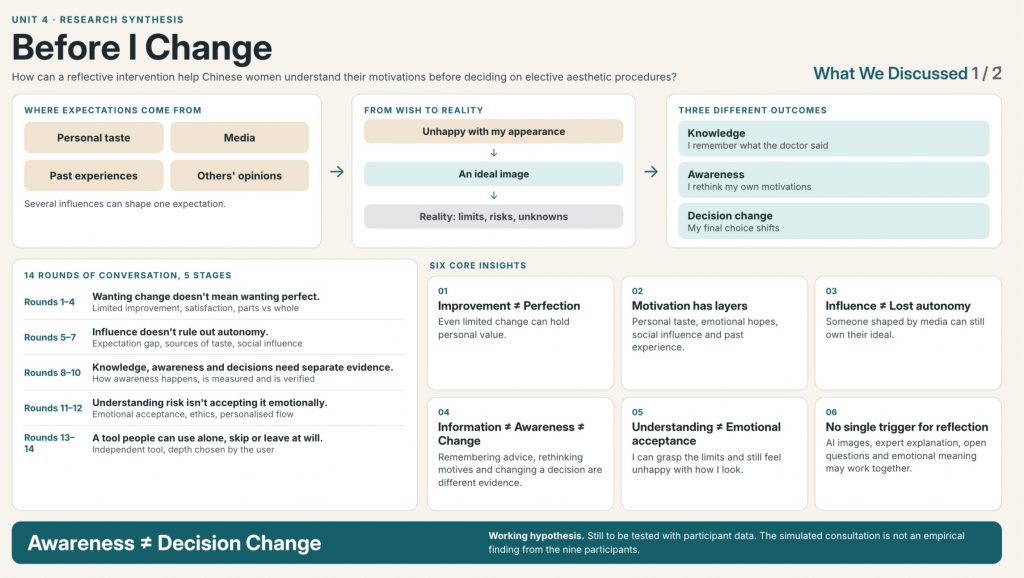
Step 1: Personal Taste
Individuals develop their own aesthetic preferences. For example, someone may prefer a more defined jawline or a softer facial contour. These preferences may reflect personal experiences and values rather than being entirely determined by external influences.
Step 2: Media
Social media, celebrities, advertising and digitally edited images may shape perceptions of ideal appearance. Repeated exposure to particular beauty standards can gradually influence what individuals consider desirable.
Step 3: Past Experiences
Previous experiences, including compliments, criticism and comparisons, may influence how someone perceives particular facial or physical features.
Step 4: Others’ Opinions
Comments from friends, family members, partners and wider society can affect appearance satisfaction. However, being influenced by others does not necessarily mean that an individual lacks autonomy.
Key Understanding:
Beauty expectations may emerge from several interacting influences rather than a single source.
Therefore, my intervention should not tell participants that their preferences are wrong. Instead, it should create opportunities for them to recognise and understand the influences behind their expectations.
2、
Step 1: Dissatisfaction with Appearance
The desire for change may begin with dissatisfaction with a particular feature. However, dissatisfaction does not necessarily mean rejecting one’s entire appearance or seeking perfection.
Step 2: Forming an Ideal Outcome
Individuals may develop a mental image of their desired appearance.
AI-generated images can make these expectations more visible and concrete. However, these images represent idealised visual possibilities rather than predictions of medical outcomes.
Step 3: Encountering Reality and Uncertainty
Professional information may reveal a gap between the ideal image and what can realistically be achieved.
This includes limitations, recovery, possible complications, individual variation and uncertainty about outcomes.
Key Understanding:
Even when someone understands that an ideal result may not be achievable, they may still value a partial improvement.
This does not automatically indicate irrational thinking. A limited change may still carry significant personal meaning.
Therefore, my intervention should explore how participants interpret and weigh realistic information rather than assuming that information will automatically change their decisions.
3、
This diagram represents one of the most important conceptual distinctions in my research.
Through the simulated consultation, we identified that knowledge, awareness and decision change are three separate processes.
Step 1: Knowledge
Participants may gain new information about medical limitations, recovery or possible risks.
This can be explored by asking what information they remember or understand.
However, remembering information does not necessarily mean reconsidering their personal motivations.
Step 2: Awareness
Awareness involves developing a clearer understanding of one’s motivations, expectations and choices.
For example, someone may recognise that wanting to change their nose relates not only to appearance but also to confidence, previous experiences or social expectations.
They may also recognise these influences while continuing to genuinely value their desired change.
Awareness does not require participants to reject their wishes. It involves understanding those wishes more clearly.
Step 3: Decision Change
After receiving information and reflecting, participants may continue, postpone, modify or abandon their original plans.
However, an unchanged decision does not necessarily mean that awareness has not occurred.
Key Understanding:
The effectiveness of my intervention should not be measured simply by whether participants decide against aesthetic procedures.
Instead, I should examine whether they can explain their motivations, expectations, concerns and reasons more clearly.
4、
Stage 1: Rounds 1–4 — Understanding the Desire for Change
We explored why someone may continue to pursue an ideal appearance despite knowing that the ideal result may not be fully achievable.
An important insight was that seeking improvement does not necessarily mean seeking perfection. Even limited change may hold genuine personal value.
Stage 2: Rounds 5–7 — Understanding Influence and Autonomy
We examined how aesthetic expectations may be shaped by social media, personal experiences and other people’s opinions.
The key understanding was that being influenced does not automatically remove personal autonomy.
Therefore, the tool should help participants identify influences rather than determine whether their preferences are authentic.
Stage 3: Rounds 8–10 — Defining Awareness
We explored what might count as evidence of deeper self-awareness.
We distinguished knowledge, awareness and decision change, and considered how participants’ own explanations might demonstrate reflection.
For example, can participants explain their motivations, recognise expectation gaps and describe how they weigh different options?
Stage 4: Rounds 11–12 — Emotion and Ethics
We considered the difference between understanding risks intellectually and accepting uncertainty emotionally.
A participant may understand realistic limitations while still experiencing disappointment or continuing to value their ideal appearance.
The design should therefore respect different emotional responses without forcing personal disclosure.
Stage 5: Rounds 13–14 — Translating Research into Design
Finally, we proposed an independent, integrated reflective tool.
The tool would include consistent core questions while allowing participants to choose their level of reflection.
They could skip, pause or exit at any point without pressure to provide a particular answer.
5、
Insight 01 — Improvement ≠ Perfection
Wanting to improve one’s appearance does not necessarily mean seeking perfection. Even a partial change may have meaningful personal value.
This challenges the assumption that appearance-related desires are always unrealistic.
Insight 02 — Motivation Has Layers
Motivations may include personal preferences, emotional expectations, social influences and previous experiences.
The tool should therefore explore not only what participants want to change, but also what that change means to them.
Insight 03 — Influence ≠ Lost Autonomy
Being influenced by media or other people’s opinions does not automatically eliminate personal autonomy.
The intervention should respect participants’ choices rather than define which preferences are independent or authentic.
Insight 04 — Information ≠ Awareness ≠ Change
Understanding information, recognising personal motivations and changing a decision are different outcomes.
Each requires separate evidence.
Insight 05 — Understanding ≠ Emotional Acceptance
Intellectual understanding of realistic limitations does not guarantee immediate emotional acceptance.
The tool should leave space for disappointment, uncertainty and continuing desire.
Insight 06 — No Single Trigger for Reflection
Deeper reflection may emerge through a combination of visual experiences, professional information, open-ended questions and emotional interpretation.
Therefore, I propose an integrated reflective tool rather than relying on one intervention method.
Conclusion:
These insights are working ideas generated through the simulated consultation, not empirical psychological findings.
They guide a design approach that supports informed personal reflection without pushing participants toward or away from aesthetic procedures.
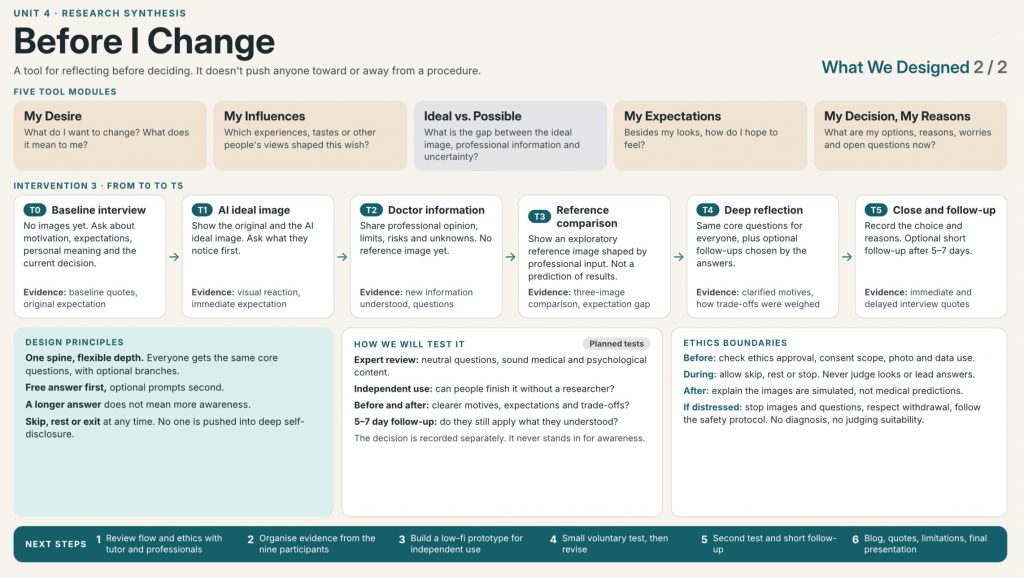
Module 1 — My Desire
Participants begin by identifying what they want to change and why that change matters.
The aim is to understand their wishes without evaluating or judging them.
Core questions:
- What do I want to change?
- Why is this change important to me?
- What do I hope will be different afterwards?
Module 2 — My Influences
Participants explore how their aesthetic expectations may have developed.
This may include media, personal experiences, other people’s opinions and individual preferences.
Core questions:
- When did I first begin wanting this change?
- Which experiences influenced my expectations?
- Which influences feel most important to me?
Module 3 — Ideal vs. Possible
Participants compare an AI-generated ideal image with professional information about realistic possibilities and uncertainty.
The aim is not to reject the ideal but to recognise potential differences between expectation and reality.
Core questions:
- Which aspects might be achievable?
- What limitations or uncertainties exist?
- How important are these differences to me?
Module 4 — My Expectations
Participants explore the emotional or personal meaning attached to the desired change.
This may include confidence, satisfaction, acceptance or simply enjoying their appearance more.
Core questions:
- Beyond my appearance, what do I hope will change?
- Do these expectations depend entirely on changing my appearance?
- Would a limited result still feel meaningful?
Module 5 — My Decision, My Reasons
Participants reconsider their choices without being required to change their original decision.
They may continue, postpone, modify or abandon their plans, or remain uncertain.
Core questions:
- What am I currently leaning towards?
- What are my reasons?
- What questions or concerns remain?
Design Purpose:
These five modules translate the abstract concept of awareness into a structured reflective process that can be experienced, documented and tested.
2、
T0 — Baseline Interview
Before presenting any images, I explore participants’ original motivations, expectations and current intentions.
This provides a baseline before visual influences are introduced.
Evidence: original motivations, expectations and interview quotes.
T1 — AI Ideal Image
Participants view their original photograph alongside an idealised AI-generated image.
I ask what they notice first, how they feel and whether the image reflects their expectations.
This stage explores their immediate responses to an ideal visual representation, rather than predicting medical outcomes.
Evidence: visual reactions, emotional responses and immediate expectations.
T2 — Doctor Information
Before showing another reference image, participants receive relevant professional information.
This may include realistic limitations, recovery, risks, complications and uncertainty.
The information should be reviewed by appropriately qualified professionals to ensure accuracy and neutrality.
Evidence: understood information, new questions and reactions to uncertainty.
T3 — Reference Comparison
Participants compare three images:
- Original photograph
- AI-generated ideal image
- Exploratory reference image informed by professional input
The third image is not a prediction of surgical outcomes. It is intended to support discussion of realistic differences and uncertainty.
Evidence: visual comparisons and recognition of expectation gaps.
T4 — Deep Reflection
This stage focuses most directly on awareness.
All participants answer consistent core questions, followed by optional questions that allow deeper exploration.
For example:
- How do I now understand my original motivation?
- Has any information changed my expectations?
- Would partial improvement still be meaningful?
- How do I weigh possible benefits against uncertainty?
Participants are not required to provide longer answers or reach any particular conclusion.
Evidence: clearer motivations, more specific expectations and explanations of trade-offs.
T5 — Close and Follow-up
Finally, participants record their current decision and the reasons behind it.
An optional short follow-up after 5–7 days can explore whether their understanding remains relevant beyond the immediate session.
Decision outcomes and awareness are recorded separately.
Evidence: immediate reflections, optional follow-up responses and explanations of choices.
Research Purpose:
By comparing evidence from T0 with T4 and T5, I aim to examine whether participants develop clearer awareness of their motivations and expectations rather than simply measuring how many change their decisions.
3、
Principle 1: One Spine, Flexible Depth
All participants encounter the same core questions, allowing for comparison across the research.
Additional reflection is optional and can vary according to individual preferences.
Principle 2: Free Answer First
Open-ended questions are presented before additional prompts.
Optional guidance is provided only when participants wish to explore further, reducing the risk of influencing their initial responses.
Principle 3: Longer Does Not Mean Deeper
Longer responses should not automatically be interpreted as deeper awareness.
The analysis should focus on the clarity and meaning of participants’ reflections rather than word count.
Principle 4: Skip, Pause or Exit
Participants can skip questions, pause or end the experience at any point.
The tool should not require personal disclosure to produce an impression of deep reflection.
Overall Principle:
The design should balance a consistent research structure with participants’ freedom to determine their own depth of engagement.
4、
Step 1: Expert Review
Relevant psychological and medical professionals review the questions, information accuracy and ethical considerations.
The review should identify potentially leading questions and visual materials that could reinforce unrealistic expectations.
Step 2: Independent Use
Participants test the tool without continuous researcher guidance.
This examines whether the experience is understandable, accessible and independently usable.
Step 3: Before-and-After Comparison
Participants’ initial and later responses are compared.
The analysis focuses on clarity of motivation, specificity of expectations, recognition of uncertainty and explanations of trade-offs.
Step 4: 5–7 Day Follow-up
An optional short follow-up examines whether participants can still articulate or apply what they previously understood.
Step 5: Separate Decision Recording
Participants’ decisions are recorded independently from evidence of awareness.
Overall Aim:
The testing process will evaluate usability, comprehension and whether the tool may support a deeper understanding of personal motivations and expectations.
5、
Before Participation
Confirm ethics requirements, informed consent, image use, data storage and deletion procedures.
Clearly explain that AI-generated images are simulations rather than predictions of medical outcomes.
During Participation
Avoid judging participants’ appearances or encouraging particular medical decisions.
Allow participants to skip questions, rest or withdraw.
If distress occurs, stop the relevant image-based activities and questions and follow the established safety protocol.
After Participation
Clarify the limitations of the simulated images and professional information.
Protect personal data and identifiable images according to consent and data-management arrangements.
Research Boundaries:
Before I Change is not a psychological treatment, diagnostic tool or assessment of medical suitability.
Its purpose is to provide a safe, non-judgemental space for personal reflection.
6、
Step 1 — Review Flow and Ethics
Discuss the overall process, questions, image use and ethical boundaries with my tutor and relevant professionals.
Step 2 — Organise Existing Evidence
Review material from the nine previous participants, including initial motivations, visual responses, reflections and decisions.
Distinguish findings supported by existing evidence from hypotheses that remain untested.
Step 3 — Build a Low-fidelity Prototype
Translate the five reflective modules into a practical prototype, including pages, questions, image comparisons and optional pathways.
Step 4 — Conduct a Small Voluntary Test
Invite a small number of volunteers to test whether the tool is understandable, independently usable and safe.
Use their feedback to revise the prototype.
Step 5 — Test Again and Follow Up
Conduct a second test with the revised version and, where appropriate, include a short follow-up.
Compare findings across iterations, focusing on usability and evidence of awareness.
Step 6 — Final Documentation and Presentation
Compile research blog entries, anonymised interview quotes, design iterations, test results, limitations and the final prototype.
The final presentation should demonstrate not only the design outcome but also the research process that led to its development.
7、
Initially, I focused on why some individuals continue to pursue an ideal appearance even when they understand that the desired result may not be fully achievable.
As the discussion progressed, I began to recognise that seeking partial improvement is not necessarily irrational, and that being socially influenced does not automatically remove personal autonomy.
This shifted my research focus from changing aesthetic decisions towards supporting a deeper understanding of motivations, expectations and uncertainty before decisions are made.
This process informed the development of Before I Change: an independent reflective tool combining visual comparison, professional information and open-ended questions.
The tool does not aim to persuade participants to pursue or reject aesthetic procedures. Instead, it aims to help them better understand why they want change and how they weigh personal expectations against realistic possibilities.
The next stage will involve testing the tool with real participants to examine whether it supports deeper awareness, while evaluating usability, ethical safety and research limitations.