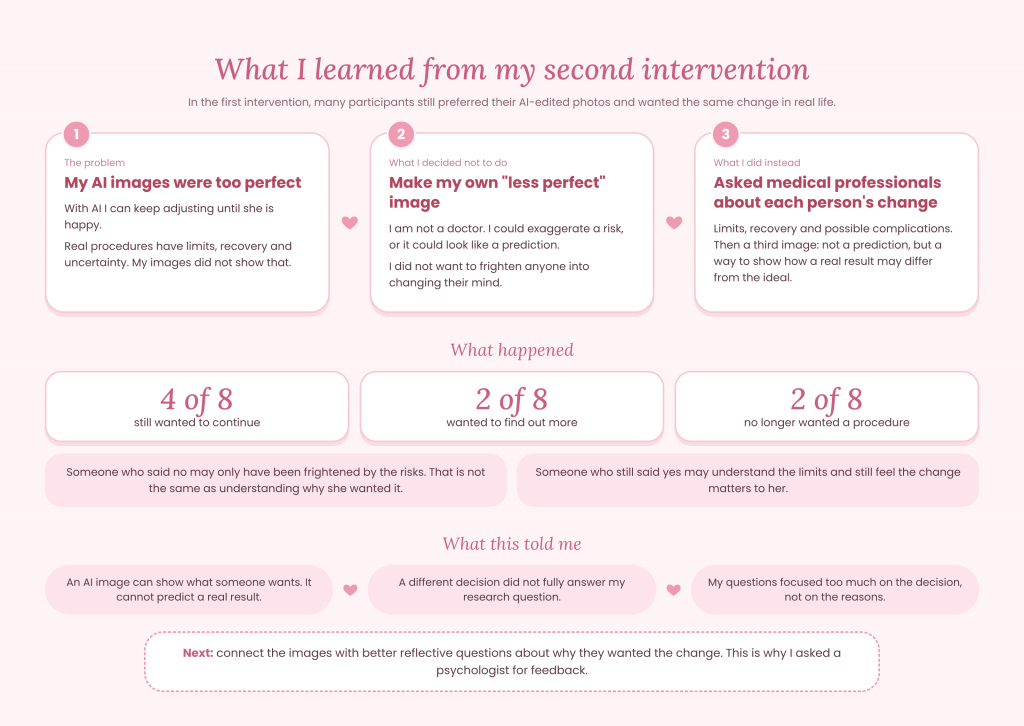
After completing my first intervention, I came across a problem that made me reconsider my research approach.
In the first intervention, I asked participants which facial features they wanted to change and why.
I then used AI to edit their original photographs based on their descriptions, trying to create an image that was as close as possible to their ideal appearance.
I hoped that comparing these images would encourage them to reconsider their choices.
However, during the interviews, I noticed that many participants still preferred their edited photographs and wanted to achieve similar changes in real life.
At first, I thought this might simply mean that they already knew what they wanted.
But later, I started wondering whether the results were also influenced by the way I had designed the intervention.
With AI, changing someone’s appearance is very easy.
If someone wants a higher nose bridge, I can make it higher. If someone wants bigger eyes, I can edit them according to her preferences.
I can keep adjusting the image until she feels happy with the result.
But real aesthetic procedures do not work in the same way.
Even if someone can clearly explain the appearance she wants, it does not mean that a doctor can achieve exactly the same result.
Everyone has different physical conditions, and real procedures involve limitations, recovery and uncertainty.
I began to feel that the images in my first intervention might have been too idealised.
They showed participants what they wanted, but they did not show what might be involved in achieving those changes.
This made me think about introducing more realistic information into my next intervention.
At first, I considered creating another edited image showing a less-than-perfect result.
For example, if a participant wanted a higher nose bridge, could I create an image where the nose was higher but the overall result was not exactly what she had imagined?
However, I soon realised that this approach had its own problems.
I am not a doctor, and I cannot know whether a particular surgical outcome is medically possible.
If I created these images based only on my imagination, I might exaggerate certain risks or present an inaccurate outcome.
Participants might also misunderstand the images and think that they were predictions of what would happen after surgery.
I did not want to make participants reconsider aesthetic procedures simply by showing them a frightening result.
That was not the purpose of my research.
My aim was not to discourage aesthetic procedures, but to help participants think more carefully about their expectations and the possible differences between ideal images and real outcomes.
Because of this, I decided to seek feedback from medical professionals.
I did not want to ask only general questions about the risks of aesthetic procedures.
Instead, I wanted to look at the specific changes that each participant was considering.
For example, for a participant who wanted to change her nose, I wanted to understand what limitations might affect her desired result and why the actual outcome could differ from the AI image.
I also wanted to learn about recovery, possible complications and other factors that participants might not have considered.
For participants who wanted to change other facial features, I wanted to follow a similar approach, focusing on information relevant to their individual wishes rather than giving everyone the same general explanation.
Through these discussions with medical professionals, I began to understand an important limitation of my original approach.
An AI image can help someone communicate what she wants, but it cannot predict the result of a real medical procedure.
This changed how I thought about the role of images in my intervention.
I no longer wanted the images to show only an ideal appearance.
I wanted them to become part of a conversation about expectations and uncertainty.
Based on the medical feedback I collected, I started developing additional visual materials and considered adding a third image.
The purpose of this image was not to predict how a participant would look after a procedure. Instead, it was intended to illustrate how a real outcome might differ from an idealised simulation.
I also began considering how to include information relevant to each participant’s intended change, such as practical limitations, recovery and possible complications.
At the same time, I wanted to keep the intervention simple and understandable for people without a medical background.
My research was not about teaching participants medical knowledge or replacing professional medical advice.
I was using this information to help them recognise that an AI simulation and a real medical procedure are not the same thing.
I then began observing whether participants reconsidered their original decisions after seeing the additional realistic information.
In the results I recorded at this stage, four out of eight participants still wanted to continue considering aesthetic procedures, two wanted to find out more information, and two no longer wanted to consider a procedure at that point.
These responses were different from what I had observed earlier.
Initially, I thought this might mean that the revised intervention was more effective.
After seeing the realistic information, some participants appeared to be thinking beyond their ideal appearance and considering recovery, risks and practical limitations.
But I soon started questioning my interpretation.
If someone decided not to have an aesthetic procedure because she was frightened by possible complications, did that really mean she understood her original motivation more clearly?
Perhaps she was simply worried about the risks.
Similarly, if someone still wanted to proceed, that did not necessarily mean she had ignored the realistic information.
She might understand the limitations but still feel that the change was important to her.
I realised that although the second intervention had produced different decisions, it had not fully answered my research question.
It helped me explore whether participants were considering realistic risks and limitations, but I still needed to understand whether they had developed a clearer understanding of their original motivations.
I also realised that my earlier questions had focused too much on the final decision and had not captured enough about the reasons behind it.
This became an important issue for the next stage of my research.
I needed to find a better way for participants to explain not only whether they still wanted an aesthetic procedure, but also why they had originally wanted it, how their expectations had developed, and which factors mattered most to them.
This was also one of the main reasons I later decided to seek further psychological expert feedback.
Looking back, the most important development at this stage was not simply adding a third image. It was recognising that my research materials needed clear reasons, reliable information and an understanding of their limitations.
I could not change the information participants saw just because I wanted them to reflect.
Both idealised AI images and images illustrating uncertainty could influence how participants thought about their appearance.
As a researcher, I needed to be more careful about how these materials were created, why I used them and how they might affect the people taking part.
This stage also helped me understand that my intervention still needed further development.
Showing participants the difference between an ideal image and medical reality might not be enough to help them understand their motivations.
I needed to connect these visual materials with better reflective questions.