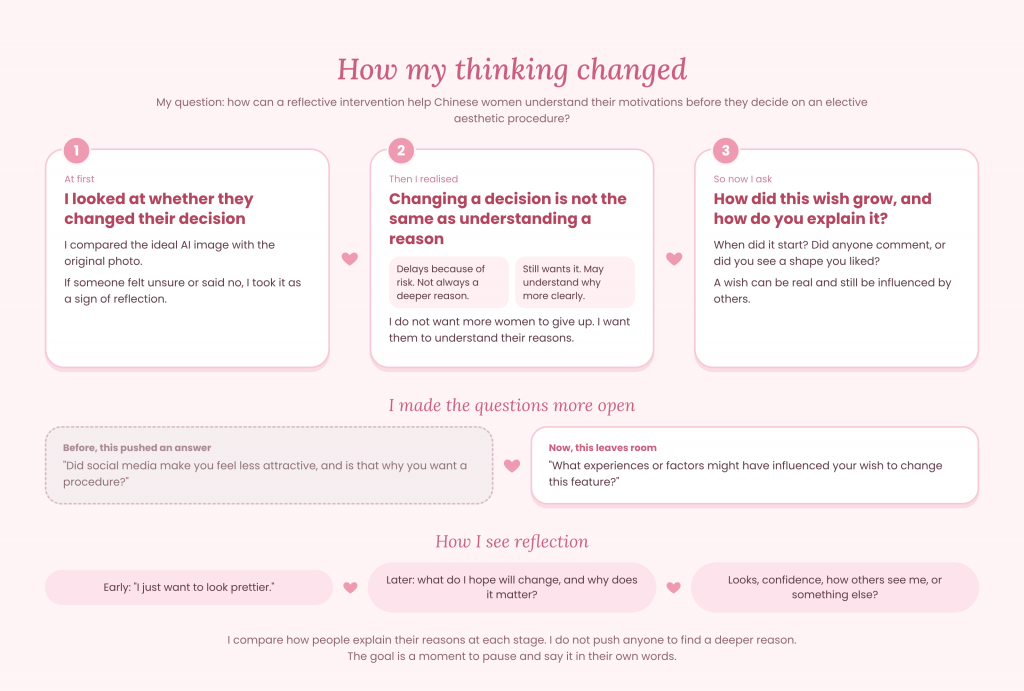
In my previous intervention, I had been using AI-edited images to help participants think about why they wanted to change their appearance.
At first, I thought that if participants could see their ideal appearance and compare it with their original photographs, they might start to reconsider their decisions.
However, after my first intervention, I realised that things were not as simple as I had expected. Many participants still preferred their AI-edited images and wanted to achieve similar changes in real life.
This made me question something important: If a participant still wanted to make the same change after the intervention, did that mean my intervention had not worked?
Initially, I was partly thinking this way. I was paying a lot of attention to whether participants changed their decisions. If someone became unsure or decided not to have an aesthetic procedure, I saw this as a possible sign of reflection.
But I gradually realised that this might not be the right way to understand the results.
For example, someone might decide to delay an aesthetic procedure because they are worried about the risks. However, that does not necessarily mean they have thought more deeply about why they wanted the change in the first place.
On the other hand, someone might still want to have the procedure after the intervention, but that does not mean they have not reflected. They might now understand their reasons more clearly and still feel that the change is right for them.
I started to realise that changing a decision and understanding a motivation are not necessarily the same thing.
This brought me back to my research question:
How can a reflective intervention support Chinese women to better understand their motivations before making decisions about elective aesthetic procedures?
I realised that my aim was not to make more women give up aesthetic procedures. What I really wanted to explore was whether they could better understand their reasons before making a decision.
I then started looking again at my interview questions.
Previously, I had focused mainly on which image participants preferred, whether they still wanted the change, and what they finally decided.
Now, I wanted to understand how these wishes developed.
For example, if a participant said she wanted a higher nose bridge, I did not want to stop at asking why she wanted it.
I wanted to explore when she first started thinking about her nose. Had anyone commented on it? Had she seen a particular nose shape that she liked? Or had it simply been her personal preference for a long time?
I also started thinking that people’s motivations might not fit neatly into two categories: personal choice or outside influence.
Someone might genuinely like a certain appearance while also being influenced by social media, beauty trends or other people’s comments.
I did not want to assume that a preference was not genuine just because it had been influenced by something external.
Instead, I wanted to create questions that gave participants space to recognise these influences themselves and think about how important each one was to them.
Between 22 and 29 October, I spent time exploring different ways of designing these reflective questions.
One thing I paid particular attention to was avoiding questions that might suggest an answer.
For example, asking:
“Did social media make you feel less attractive, and is that why you want an aesthetic procedure?”
already suggests a particular explanation.
I started considering a more open question:
“What experiences or factors do you think might have influenced your wish to change this feature?”
This would allow participants to describe their own experiences without being pushed towards my assumptions.
At the same time, I began thinking about how I could recognise whether meaningful reflection had taken place.
I realised that I could not judge this only by whether someone changed her decision. I also could not assume that a longer answer automatically meant deeper understanding.
Instead, I wanted to compare how participants explained their motivations at different stages.
For example, someone might initially say, “I just want to look prettier.”
After further discussion, could she explain what she hoped would change? Why did this matter to her? Was she expecting a change in appearance, confidence, how other people saw her, or something else?
Of course, not every participant would have these expectations. I did not want to push anyone to find a deeper reason simply because I expected one.
This stage made me realise that I needed to change not only the content of my intervention, but also the way I evaluated it.
Previously, I was mainly recording what participants decided.
Now, I wanted to understand how they explained those decisions.
This also encouraged me to think about developing more focused reflective questions in my next intervention, rather than relying mainly on visual comparisons.
For me, this was an important change in my research.
I did not want my intervention to lead participants towards one particular decision.
I wanted to create a moment in which they could pause, reconsider their thoughts, and explain their own reasons in their own words.